Sign up for the farmnewsNOW newsletter
(Nicole Reis/meadowlakeNOW Staff)
Top Notch Farming

Local growers discuss best farming practices to avoid prevalent pathogens found in soil

Feb 5, 2020 | 12:48 PM

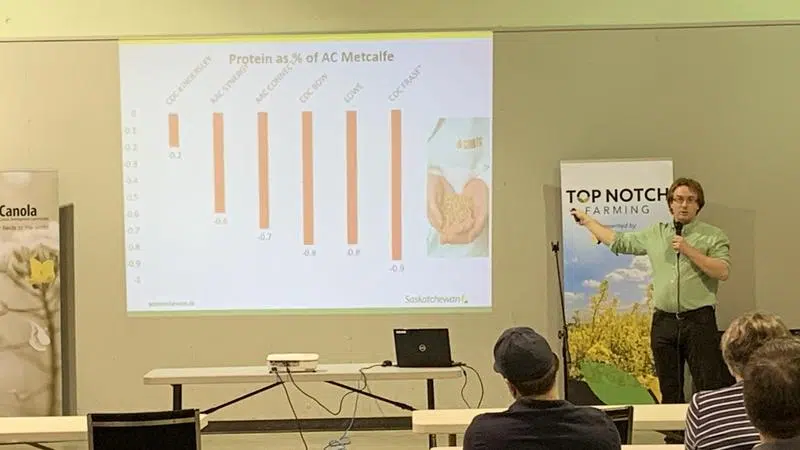
The Top Notch Farming seminar held in Meadow Lake Tuesday was put on by SaskCanola in partnership SaskBarley, SaskPulse, Co-op Agro and representatives with the Ministry of Agriculture who met with growers in the region to discuss good growing practices.

Bernie McClean, canola grower in Glaslyn and director with SaskCanola told meadowlakeNOW, a majority of the agenda covered good growing practices in order to avoid prevalent soil-borne crop diseases such as clubroot in canola crops and root rot in pea crops.

“This is a means of getting information out to growers that SaskCanola has been working on behind the scenes as far as research goes,” he said. “We have a pretty good handle on the disease but we want to make sure growers are aware of what’s going on, what are the best management practices are and continue with surveys so that we know where it is in the province of Saskatchewan.”

According to McClean, Clubroot came to light in Alberta in 2003 and is spreading across prairies and is showing signs in Saskatchewan and Manitoba.


He said initial detection in Saskatchewan canola crops came approximately six years ago

“Were doing surveys now so we’re looking for it more readily and we’re finding new cases usually small numbers every year,” McClean added.

Rotating crops has been identified as a way to combat the disease and McClean said seed companies are able to breed resistance varieties of seed lines, though the crop-killing pathogen has shown the ability to overcome resistance varieties.

McClean said good agronomic practices are the best management practices and rotating crops avoids the pathogen by getting at least a two year breaks between canola crops.

“The province has learned a lot from Alberta, because it was first discovered there. The pathogen had got to the point where it devastating crops there, or reducing crop yields,” he said.

This was the first Top Notch Farming seminar presented to Meadow Lake growers.

Root Rot

Sherrilyn Phelps, agronomy manager with SaskPulse Growers discussed managing Root Rot in peas and the latest pathogen mutation wreaking havoc on local pea crops.

According to Phelps, the mutation of the Root Rot pathogen called Aphanomyces began showing signs in local pea crops in 2012 then blew up in 2014 and is still an on-going issue in northwest Saskatchewan.

Phelps said the Aphanomyces pathogen functions differently, its life cycle and its management strategy is different than other four strains of Root Rot.

The pathogen causes a rotting of the root where they become unhealthy and cannot take up nutrients from soil and effects yields and health of crop.

“Our soil has millions of different organisms and the more times you grow a host crop, and the more times a crop is grown which is susceptible to a particular disease, the more it builds up,” she said. “Over time, it’s built up enough where it really causes some devastation in that crop.”

Phelps said the first field identified with the Aphanomyces Root Rot, and the worst of the pathogens was found east of Glaslyn since 2012 is still an ongoing issue. The pathogen has now spread across Western Canada.

One of the biggest ways we can manage the disease is by extending our rotation. That means instead of growing peas every three to four years, we should be growing them every six to eight years by allowing more time in between crops to allow pathogens to die down in the soil.

Keeping plants healthy is the first step to mitigating the risk such as field choice, managing agronomy, making sure there is good fertility in feeding crops and minimizing stresses.

“We now understand what’s involved because growers are looking more closely at roots so were hearing more about it because they’re looking for it,” she said. “Growers understand how severely it can affect the yield potential so growers are trying to make informed decisions prior to growing the crop and minimizing the impact of root diseases.”

SaskCanola works with 23,000 canola growers in the province.

nicole.reis@jpbg.ca

Twitter: @nicolereis7722

View Comments