Sign up for the farmnewsNOW newsletter
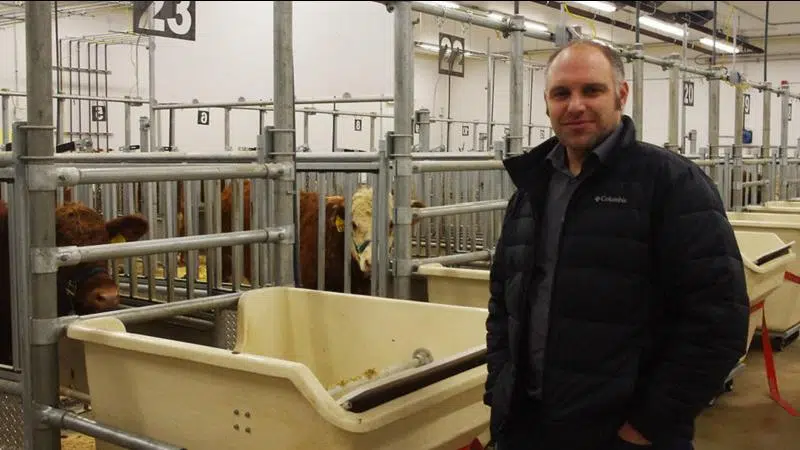
Dr. Greg Penner at the Livestock and Forage Centre of Excellence. (submitted photo/University of Saskatchewan)
LIvestock Research

Research continues on water quality for livestock

Feb 4, 2020 | 3:46 PM

It was a good day for Greg Penner.

The associate professor at the University of Saskatchewan (USask) had three research projects approved under the Canadian Agricultural Partnership.

The announcement was made by Agriculture Minister David Marit at the Saskatchewan Beef Industry conference on Jan. 29. Nearly $8.1 million in funding will go to 28 livestock and forage-related research projects through Saskatchewan’s Agriculture Development Fund (ADF).

Penner was particularly excited about continuing research on water quality for livestock.

“Saskatchewan has a lot of water, but water sometimes limits our ability to use the vast rangeland that we have because the quality isn’t suitable for livestock,” he said. “We’re looking at ways that we can help refine what those water quality recommendations are, and how we hopefully can reduce the impact of low water quality for cattle while making sure it’s still safe.”

In July 2017, 200 cattle in a grazing pasture near Shamrock, Sask. died due to poor water quality. Penner said this research is important to the industry.

“We completed a project with the Ministry of Agriculture through the strategic field program, where we established sulfate concentrations that should be tolerable for cattle. We were able to show the current recommendations are maybe a little bit too low, a little bit too stringent,” he said. “That doesn’t mean we should accept poor water quality. Cattle health is the primary factor that we want to evaluate. But there are new technologies or existing technologies that we can apply to help correct for that poor water quality. That’s really what this project will deal with.”

Penner said one of the compounds they’re looking at is bismuth subsalicylate which is an ingredient found in Pepto-Bismol.

“The active ingredient in Pepto-Bismal binds to sulfides, which is what’s produced in the rumin of cattle when they drink high sulfate water. If we can bind those sulfides we can reduce the risk of potentially high sulfate water, but it has never been tested. That’s what this funding is allowing us to investigate,” he said.

The other two projects Penner will work on will concentrate on livestock feed.

“We want to develop new forage varieties that have enhanced digestibility which, hopefully, allows those forages to be used at a greater efficiency, reduce greenhouse gas emissions and increase the efficiency of beef production,” he said. “The third one is looking at a new forage variety, hybrid rye. This is a commercial variety that has been brought in but there’s really no data on how to use that hybrid rye as a silage source for cattle. These will be our major activities over the next three years.”

The livestock industry has taken a beating in the press and in public opinion. Penner said having both levels of government funding research sends a message.

“The government is there to represent the general public. They are at arms length and their job is to make sure the research conducted is independent and meets society’s well being or long term interest. With this funding we’re able to conduct research, objectively, show the science, present it back to the government as well as the industry. Hopefully the right kinds of decisions move forward,” he said.

Penner said this high level of research can only happen because of the Livestock and Forage Centre of Excellence (LFCE) located near Clavet.

“From the LFCE perspective, we have a amazing research facility which is brand new, state of the art, allowing us to do a lot of research that could not be done elsewhere,” he said. “Seeing the government continue to support our facility means the world to us and allows us to do the kind of research that we’re trying to get done.”

alice.mcfarlane@jpbg.ca

On Twitter: @AliceMcF

View Comments